Introduction
Securing a trademark registration in South Korea is a key milestone for foreign companies, but obtaining a certificate from the Ministry of Intellectual Property (MOIP) does not guarantee permanent ownership. Under Korean IP practice, registered marks face potential cancellation if left unused for an extended period.
A recent Patent Court decision highlights how this legal mechanism operates. In a case represented by Ideachang International Patent & Law Firm, the court affirmed an Intellectual Property Trial and Appeal Board (IPTAB) decision to revoke a registered trademark due to a lack of proven commercial use in South Korea.
This ruling provides important insights for overseas brand owners, foreign enterprises, and multinational corporations expanding into the Korean market regarding how trademark maintenance and evidence collection work under local law.
News Overview: Patent Court Upholds Non-Use Cancellation
The recent litigation centered on whether a trademark owner had actively used its registered mark on designated goods within South Korea during the statutory three-year window prior to the cancellation petition.
[3-Year Inactivity Window] ──> Non-Use Trial Filed ──> Trademark Owner Submits Proof ──> Insufficient Local Evidence = Registration Cancelled
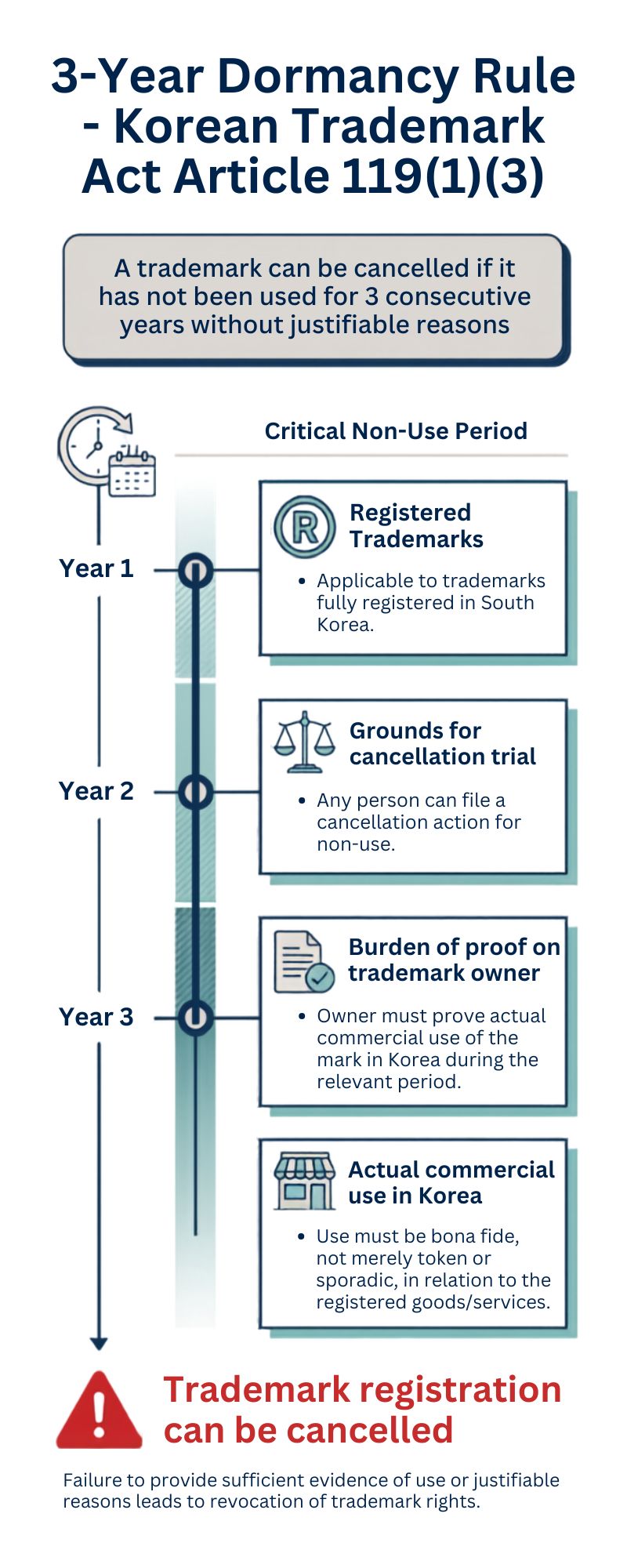
Case Highlights from the Ruling
- Initial Administrative Decision: The IPTAB ruled that the materials submitted by the trademark owner were insufficient to prove legitimate commercial use in Korea and that no valid legal justification for non-use existed.
- Appeals Court Affirmation: The trademark owner appealed the decision to the Patent Court, but the court dismissed the petition, agreeing that the registration should be canceled.
- Strict Goods Identity: The Patent Court emphasized that proof of usage must correspond directly to the designated goods specified in the registration, taking into account product function, purpose, consumer base, and trade context.
What is a Non-Use Cancellation Trial in South Korea?
Under Article 119(1)(3) of the Korean Trademark Act, any interested party can file a cancellation trial before the IPTAB if a registered mark has not been legitimately used in South Korea by the owner or a licensee for three consecutive years without a valid reason.
Core Features of Non-Use Cancellation Actions:
- Burden of Proof on the Owner: Once a non-use trial is initiated, the legal burden rests entirely on the trademark owner to prove active commercial use within the three-year statutory period.
- Territorial Limitation: Marketing or sales records generated outside South Korea generally do not count as proof of local commercial usage.
- High Standard for Justification: Non-use is excused only under exceptional circumstances, such as government-imposed import bans or unforeseen statutory restrictions.
What Evidence Proves Commercial Use in Korea?
To defend a registration against a non-use challenge, trademark owners must present clear, localized documentation demonstrating actual trade activity within South Korea.
Commonly Recognized Evidence
- Korean Invoices and Tax Documents: Official commercial receipts, customs clearance manifests, and tax bills clearly identifying the trademark and specific products sold in Korea.
- Localized Marketing Materials: Print advertisements, promotional brochures, and targeted digital marketing campaigns created in the Korean language.
- E-Commerce Transaction Records: Verified storefront listings, order receipts, and transaction histories from local e-commerce platforms (such as Coupang or Naver Smartstore).
- Physical Product Packaging: Product containers, hangtags, and instruction manuals displaying the registered mark along with required Korean regulatory labels.
Practical IP Strategies for Overseas Brands
Based on recent judicial precedents and general industry practices, foreign companies operating in or entering the Korean market often implement the following trademark strategies:
- Coordinate Registrations with GTM Timelines: While early filing is recommended, securing a trademark registration more than three years prior to local product distribution can create non-use vulnerabilities.
- Maintain Continuous Local Archives: Establish routine compliance procedures to collect localized sales logs, Korean marketing collaterals, and distribution contracts on an annual basis.
- Evaluate Non-Use Options for Portfolio Conflicts: If an entering foreign brand finds its name blocked by an inactive local registration, a non-use cancellation trial offers a statutory pathway to clear dormant marks that have remained unused for over three years.
Conclusion
This Patent Court decision demonstrates that under South Korean trademark practice, formal registration secures a right, but actual commercial use maintains it. As MOIP continues to update its administrative frameworks, monitoring dormant marks and maintaining localized transaction records remain central to effective portfolio management.
General Checklist for Brand Owners:
- Audit Korean trademark portfolios to identify marks approaching three years of inactivity.
- Archive localized invoices, Korean promotional collaterals, and packaging samples annually.
- Confirm that actual commercial products match the specific designated goods on official registration certificates.
- Consult qualified local patent attorneys or legal professionals to review vulnerable registrations or legal options.
Disclaimer: This article is provided for general educational and informational purposes only based on publicly reported judicial decisions and does not constitute formal legal advice. Foreign enterprises seeking specific legal counsel regarding South Korean trademark matters should consult a licensed patent attorney.
출처: https://www.etnews.com/20260723000417
“사용하지 않는 상표, 언제든 취소될 수 있다”… 아이디어창 국제특허법률사무소, 특허법원
신제품 개발과 브랜드 경쟁이 치열해지는 가운데, 등록만 받아놓고 실제 사용하지 않는 상표는 언제든 취소될 수 있다는 점을 다시 한번 확인한 특허법원 판결이 나왔다. 아이디어창 국제특허
www.etnews.com
'Korea IP Data' 카테고리의 다른 글
| Asia’s Growth and South Korea’s Role in Global Trademarks (0) | 2026.07.29 |
|---|---|
| MOIP's AI System (IPNEX): IP Strategy for Foreign Companies in South Korea (0) | 2026.07.27 |
| Korea's 5x Fine on Brand & Design Theft (0) | 2026.07.20 |
| Madrid Protocol South Korea: Pros, Cons, Refusal Risks (0) | 2026.07.13 |
| KIPRIS Trademark Search for Foreigners: A Step-by-Step English Guide (2026) (0) | 2026.07.11 |


