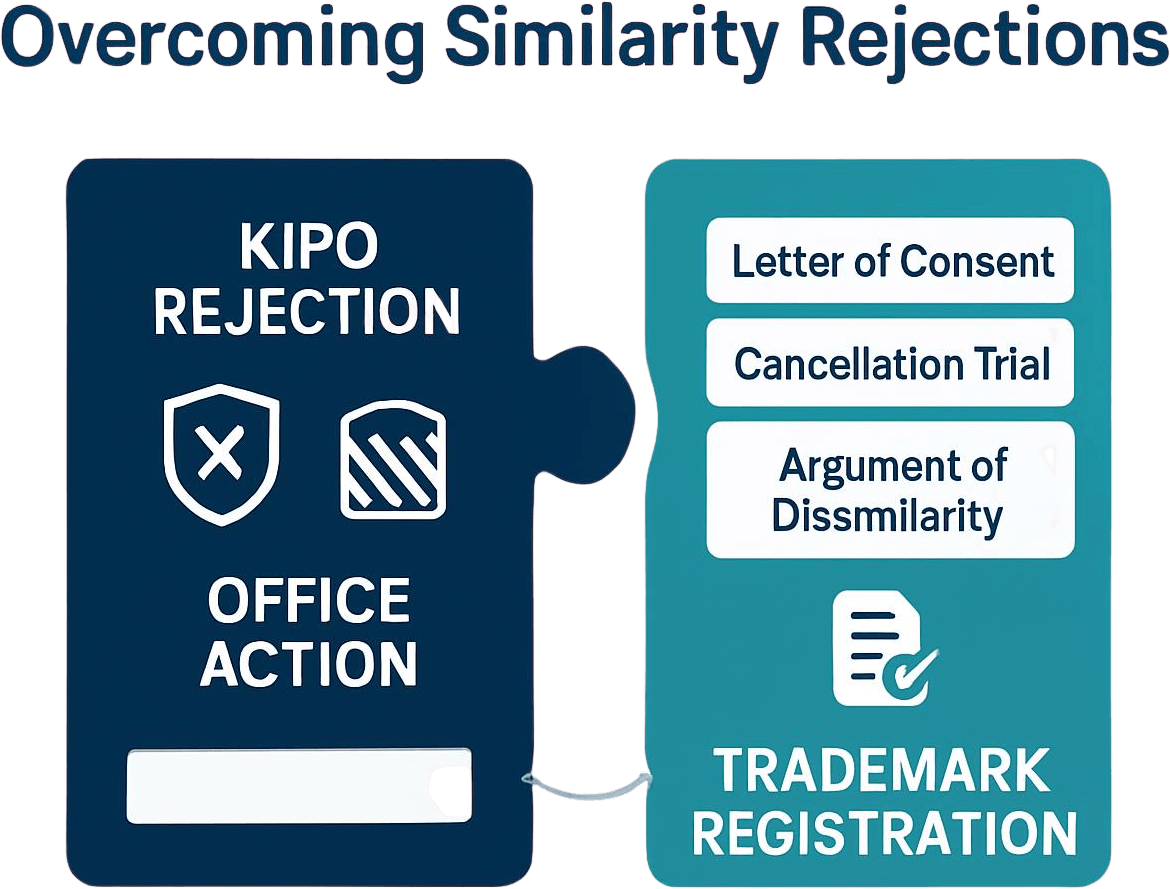
Receiving a Notice of Preliminary Rejection (Office Action) from the Ministry of Intellectual Property(MOIP), which is formerly known as 'Korea Intellectual Property Office (KIPO)' can be a stressful moment for any global brand manager. In fact, nearly 40% of all trademark rejections in South Korea stem from conflicts or similarities with a pre-existing senior trademark (인용상표).
However, a preliminary rejection is not a final refusal; it is an invitation to respond with legal strategy.
When your application is blocked by a senior mark, standard arguments regarding "lack of similarity" aren't your only options. Here are two highly effective, advanced strategies utilized by veteran local law firms to bypass or dismantle conflicting trademarks.
Strategy 1: Use Investigation & The 3-Year Non-Use Cancellation Trial
South Korea operates strictly under a "First-to-File" system, meaning whoever applies first wins the initial rights, regardless of whether they have launched the product yet. However, the law does not protect "zombie trademarks"—marks that are registered but left completely abandoned.
If a senior mark blocks your path, your legal representative can initiate a formal Trademark Use Investigation (사용조사).
The 3-Year Rule (불사용취소심판)
Under the Korean Trademark Act, if a registered trademark has not been actively used in commerce within South Korea for three consecutive years, any interested party can file a Non-Use Cancellation Trial.
- The Process: Your attorney digs into local market data, import records, and e-commerce platforms to verify if the owner has sold any goods under that mark.
- The Outcome: If no commercial use is found within the past 3 years, you can file to cancel their registration. Facing a cancellation trial, many senior mark owners will either abandon the mark or agree to assign it to you at a low cost.
Strategy 2: The New MOIP Letter of Consent System (Co-existence Agreements)
What happens if the use investigation reveals that the senior mark is actively operating in South Korea? Previously, you were out of luck, as MOIP famously did not accept co-existence agreements. Applicants had to resort to risky and expensive "assignment back" loops.
That changed dramatically with a major legal upgrade. South Korea officially enacted the Letter of Consent System (상표 공존동의제도).
💡 What is the Letter of Consent System?
It allows a junior trademark to be registered despite an older, similar trademark, provided the owner of the senior mark signs an official written consent allowing both brands to co-exist in the marketplace.
Through a legal representative, you can formally contact the senior mark owner to negotiate and request a consent agreement.
Crucial Limitations of the Consent System
While highly effective, MOIP places a few strict guardrails on this new mechanism to protect local consumers from absolute confusion:
| Requirement Category | Acceptable Scope | Prohibited Scope |
|---|---|---|
| Mark & Goods Identity | Similar Mark / Identical Goods Identical Mark / Similar Goods | 100% Identical Mark AND Identical Goods |
| Agreement Format | Simple, absolute consent form | Conditional or blanket agreements (e.g., limiting regions or timelines) |
| Post-Registration Rule | Honest concurrent use in trade | Unlawful use meant to deceive or cause consumer confusion |
⚠️ Note: If a mark registered via a consent letter is later used unfairly to intentionally deceive consumers, any third party can file a lawsuit to cancel that trademark.
Choosing the Right Path for Your Brand
When hit with a similarity rejection, navigating MOIP's strict administrative rules requires a tailored approach based on active market data.
- Choose Strategy 1 if the blocking mark appears to be an inactive defensive registration or a squatted asset.
- Choose Strategy 2 if the blocking mark belongs to a non-competing business or an entity open to corporate cross-licensing and formal co-existence agreements.
Partnering with an experienced local patent attorney ensures that your use investigations are thorough and your consent negotiations are drafted cleanly—maximizing your chances of securing market entry in South Korea.
(Disclaimer: This article is for informational purposes only and does not constitute formal legal advice. For specific statutory pricing questions, consult a licensed attorney specializing in Korean Intellectual Property Law.)


